

Optimise content for GEO with a practical pilot: choose the right pages, improve their evidence, verify access and measure what actually happens.
Your team has added FAQs, rewritten introductions and run the website through an AI visibility tool. The score has improved. The next question is harder: which pages are becoming useful sources, and what should you change next?
To optimise content for GEO, connect real buyer questions to accurate, accessible pages, then verify how search and answer services retrieve, cite and represent them. Run a small, documented pilot before scaling the work. Keep source access, citations, factual accuracy and business outcomes as separate checks.
Generative engine optimisation is the practice of improving how your content can be discovered and used in generated answers. It builds on useful content and sound technical SEO. If you need the definition first, read our explanation of GEO. This guide puts that idea into an implementation process.
- The original GEO research paper introduced a 10,000-query benchmark and reported visibility improvements of up to 40% in its experimental setting. That is research evidence, not a universal forecast for your traffic.
- An October 2026 preprint studied 158,099 answers and 468,037 citations across two markets. Its findings make a strong case for examining relevance and retrieval rather than treating page features as a citation checklist.
- Pew’s 2025 browsing analysis found traditional-result clicks on 8% of visits with a Google AI summary, compared with 15% without one. Being visible and receiving a visit are different outcomes.
1. Optimise content for GEO with a focused pilot
Begin with a small group of pages that help customers make a decision your business can serve. A focused pilot gives the team a manageable set of changes, a named owner and a baseline against which to review the work.
Choose one important offer, its main service or product page and the genuinely useful supporting resources. For a CRM implementation service, these might explain data migration, integrations, project responsibilities and cost factors. The purpose is to answer a connected buying decision, not to publish a page for every wording of a keyword.
Before editing, record:
- The customer decision: what the reader is trying to choose or understand.
- The URLs: existing canonical pages and any specific content gap that warrants a new one.
- The accountable people: the editor, the person approving factual claims and the person handling technical changes.
- The baseline: current search evidence, observed AI answers and relevant enquiry or purchase records.
If you cannot access Search Console or analytics, record that gap and request the right access. Do not replace missing measurements with zeroes. A manual observation log can start immediately, while access is arranged.
2. Map the questions buyers need answered, not a fictional fan-out count
Research the questions that make the buying decision difficult, then assign each one to an appropriate page. Use real search evidence and customer language to judge the gap; a model-generated question list is a starting hypothesis.
For the CRM example, a broad question such as Which implementation approach fits our service team? can lead to several useful decisions: what data must move, what integrations matter, who approves changes and what disruption is acceptable.
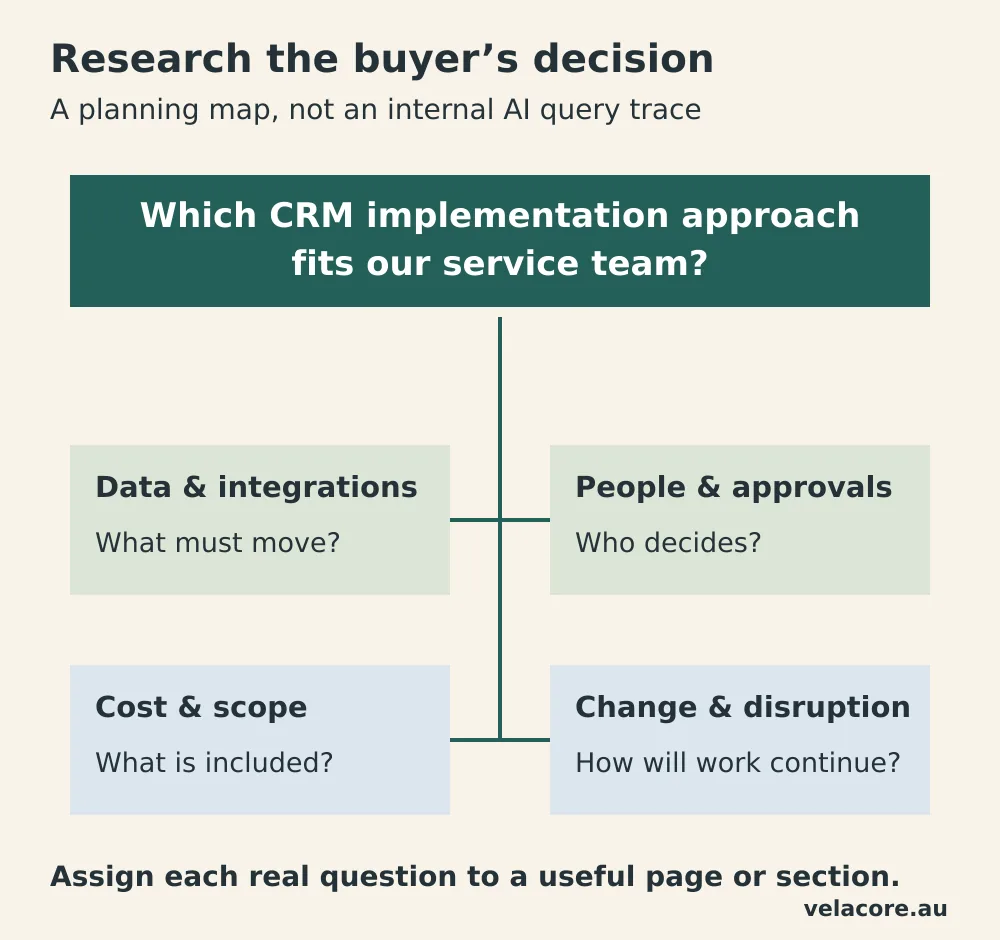
Check Search Console queries for existing pages, search results and their follow-up questions, and questions the sales or delivery team actually receives. Record where each question came from. Do not call a handful of search results proof of high search volume.
Google documents that AI Overviews and AI Mode may use query fan-out, issuing related searches across subtopics and sources. The documentation does not give publishers a fixed number of searches to target or reveal every internal query. A prompt asking an assistant to invent sub-questions does not expose that internal process.
Use the resulting map to make an editorial decision. Answer closely related questions together when that helps the reader; use separate pages when the task, evidence or audience genuinely differs. Connect those pages with descriptive internal links.
Research the decision. Do not manufacture a map of a system you cannot inspect.
3. Build a source record that keeps each claim within its evidence
Give important claims an identifiable source, an approval owner and a scope. The useful question is whether the evidence supports the sentence you are publishing, not how many links you can add.
A product document saying CSV import is supported supports a statement about importing CSV files. It does not establish that a customer’s data needs no cleanup, that every integration transfers automatically or that migration causes no disruption. Those are additional claims requiring additional evidence.
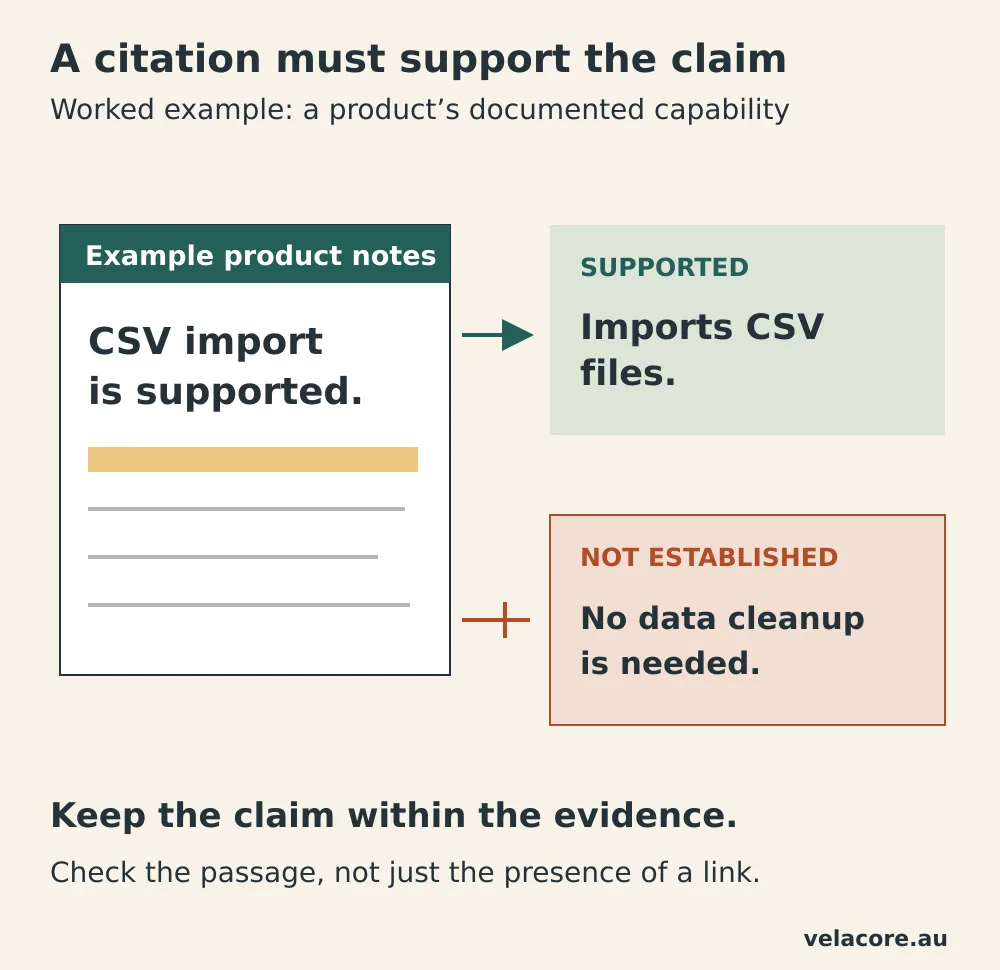
Use official product documentation for current capabilities, original research for numerical findings and actual delivery records for first-hand results. Place the link beside the claim and explain the part that changes the reader’s decision. Give a study’s date, population and method where those limits matter.
The October 2026 study by Mahe Chen and Nick Koudas compared pages within the same websites and replayed questions through engine APIs. Matching questions in meaning and retrieval patterns explained more than simple page-feature prescriptions. It does not establish a permanent formula for every engine; it gives your pilot a more useful question: does this page answer the decision being searched?
That is also why the earlier GEO experiment’s visibility results should not become a promise of 40% more enquiries. The measured outcome, tested systems and commercial outcome are different things. Keep that distinction attached to the number.
4. Make the page useful as a source and readable as a whole
Write the answer where a reader expects it, then supply the reasoning, evidence and consequences. A section should make sense when encountered independently while still contributing to the article’s overall argument.
For the CRM page, a section about migration responsibilities should explain who cleans the source data, who approves the mapping and who checks the imported records. A generic paragraph about digital transformation does not resolve that uncertainty.
Use the format that helps the reader:
- A direct paragraph for the main answer and its important condition.
- A list for parallel requirements, steps or choices.
- A real HTML table for options compared against the same criteria.
- A diagram for a relationship that is difficult to follow in prose.
- A relevant example for an otherwise abstract decision.
There is no need to force every answer into a 40-to-60-word box. Google’s AI optimisation guidance rejects prescribed chunking and special writing formulas for Google Search. Keep the explanation as short or detailed as the task requires.
Use images to explain something distinct and put the essential facts in HTML too. Describe meaningful images accurately, make charts proportionate and include captions that identify the evidence. If a video matters, provide a useful transcript or equivalent explanation.
A worked GEO edit: replace the slogan with the useful answer
Consider a hypothetical website-migration page. The buyer wants to know whether a rebuild can retain their current public addresses. A useful answer explains the route decision and its exception.
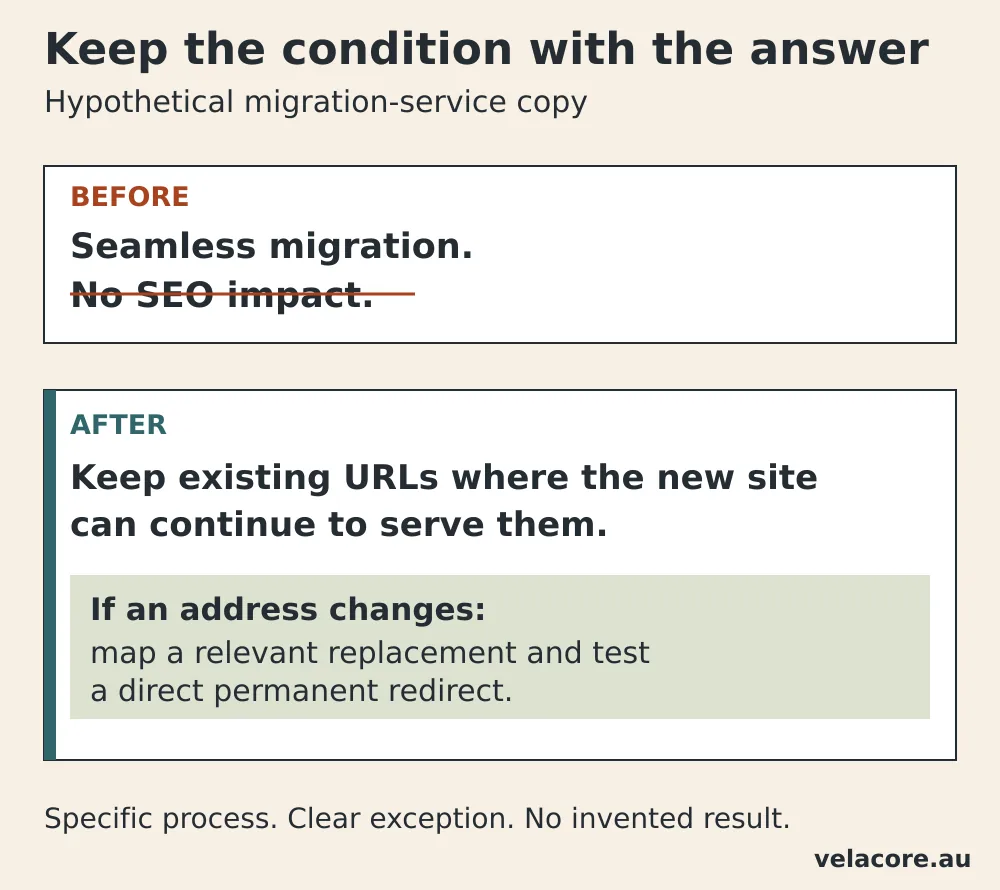
| Before | After |
|---|---|
| Seamless website migration with no SEO impact. | A rebuild can retain existing public URLs when the new website is configured to serve them. If an address must change, map it to the most relevant replacement and test a direct permanent redirect. Also check the page content, internal links and canonical tags before launch. |
The new version gives the reader three useful facts: addresses can be preserved, changed addresses need a relevant destination, and the migration involves more than installing redirects.
Google’s redirect documentation explains how redirects communicate a change of location. It supports the redirect part of the answer. It does not support a promise that a rebuild can have no effect on search performance.
Read that section without the preceding paragraphs. Replace vague references such as “It keeps them safe when this changes” with the actual subject: “A URL inventory helps the migration team identify which old addresses need a replacement when the website structure changes.” The section can stand on its own while still developing the page’s argument.
5. Check which search and retrieval controls apply to each platform
Manage crawler access by purpose. Google Search, ChatGPT search, Claude search, training collection and user-requested page visits are not one shared service controlled by one robots.txt setting.
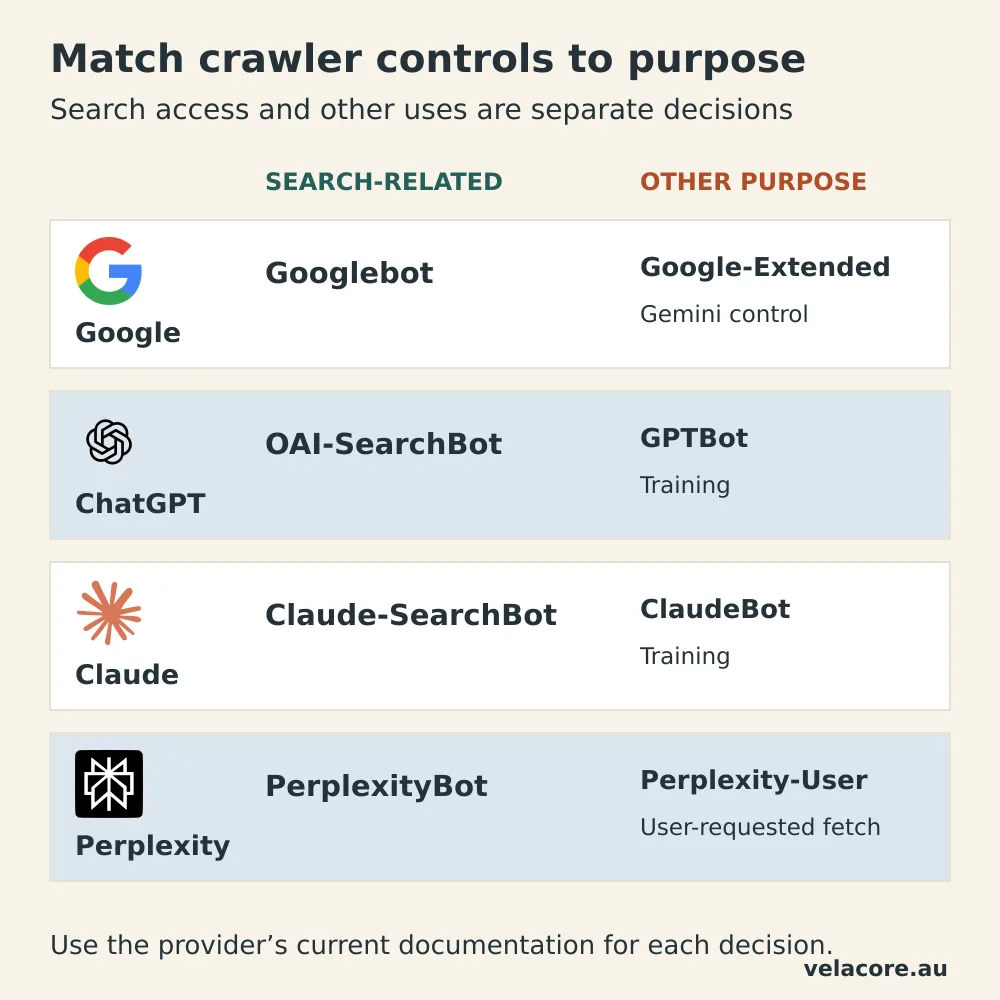
| Service | Search-related control | Important distinction |
|---|---|---|
| Google AI Overviews and AI Mode | Google Search crawling, indexing and applicable preview controls | Google-Extended controls specified Gemini training and grounding uses; it does not control inclusion or ranking in Google Search. |
| ChatGPT search | OAI-SearchBot | OpenAI distinguishes search from GPTBot training collection and ChatGPT-User visits initiated by users. |
| Claude search | Claude-SearchBot | Anthropic distinguishes Claude-SearchBot, ClaudeBot and Claude-User. Claude’s crawler does not control Google AI Overviews. |
| Perplexity search | PerplexityBot | Perplexity documents Perplexity-User separately for user-requested retrieval. PerplexityBot is not a foundation-model training crawler. |
Review the site’s actual robots.txt, applicable indexing directives and firewall events with the person responsible for the website. A permitted robots rule does not override a firewall challenge, and a blocked request does not prove the content is poor.
Check the providers’ current identity-verification guidance before making a narrow access change. Do not trust a user-agent name alone or disable site-wide protection. User-requested fetchers also have platform-specific behaviour: OpenAI says robots rules may not apply to ChatGPT-User requests, and Perplexity says its user fetcher generally ignores them. Do not treat that as permission to bypass access controls.
For Google AI features, the documented starting condition is an indexed page eligible to appear with a snippet. Check the intended canonical URL and any controls that restrict its use. Being eligible gives the page a route into consideration; it does not select the source for a particular answer.
6. Publish a complete page, then test the actual output
Verify what the public URL serves after the change. The editor, a local preview and a passed schema test each show only part of the publication.

Publish the agreed revision to the original URL where possible. Keep an accurate title, description, byline, meaningful dates and internal links. For an established page, do not move the address simply to improve a keyword score. Link any intentional move directly to its relevant replacement.
Then use Google’s URL Inspection tool to check the indexed URL and run a live test after substantive changes. Inspect the rendered content and available resources. A successful live test shows accessibility at that moment, not a guarantee of indexing or citation.
Use structured data to describe the real page. Google’s structured-data policies require representative, accurate markup; adding schema does not repair misleading content. Keep one authoritative Article graph rather than stacking plugins and pasted duplicates.
Velacore’s marketing pages and WordPress blog have separate publishing paths. Updating an article does not automatically update a static marketing card that displays it. The practical lesson is straightforward: check every surface that publishes the changed fact, not just the editor where it was changed.
7. Measure citations, supported claims and visits separately
Use a repeatable observation record for the pilot’s real questions. Record the question, platform, model or product mode, locale, date, cited URL and the claim attached to that source. An answer can mention the brand without citing the page, or cite the page while misrepresenting what it says.
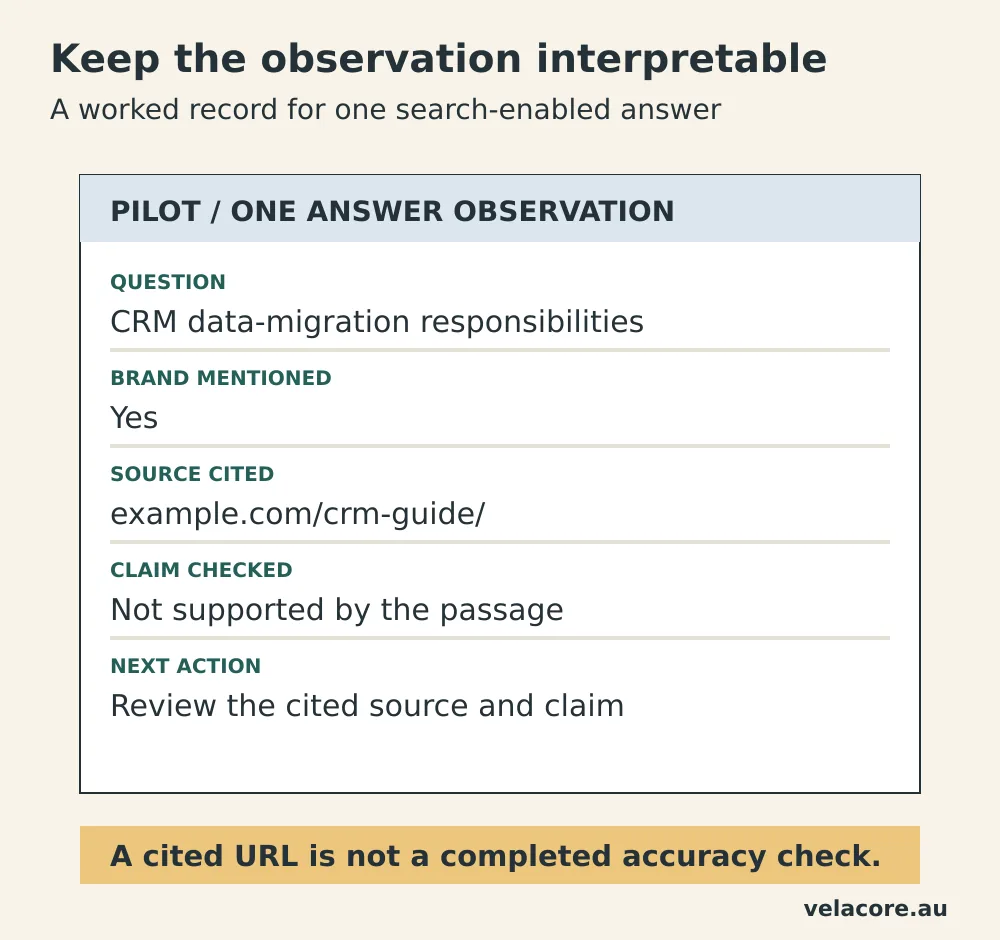
For example, if five of 20 eligible recorded answers cite the intended page, the observed citation rate is 25% for that sample. That is not a 25% share of all searches. If you rerun the same 20 questions, keep the two runs identifiable rather than silently comparing 20 questions with 40 answer observations.
Keep a consistent test method and retain evidence of the answer. Decide in advance how to record missing answers, unavailable search modes and platform failures. A direct request to read your URL tests a different capability from an unprompted buying question; do not combine their results.
| Question | Evidence to record | What it does not establish |
|---|---|---|
| Can the service access the page? | Relevant crawl/fetch evidence, directives and publication checks | That the answer selected it |
| Did the answer cite the intended page? | Actual source URL, prompt, mode, locale and date | That the linked passage supports every claim |
| Is the cited claim supported? | Comparison of the answer’s claim with the source passage | That a visitor arrived or made an enquiry |
| Did useful activity follow? | Identifiable referrals and accepted business outcomes | That one edit caused the result |
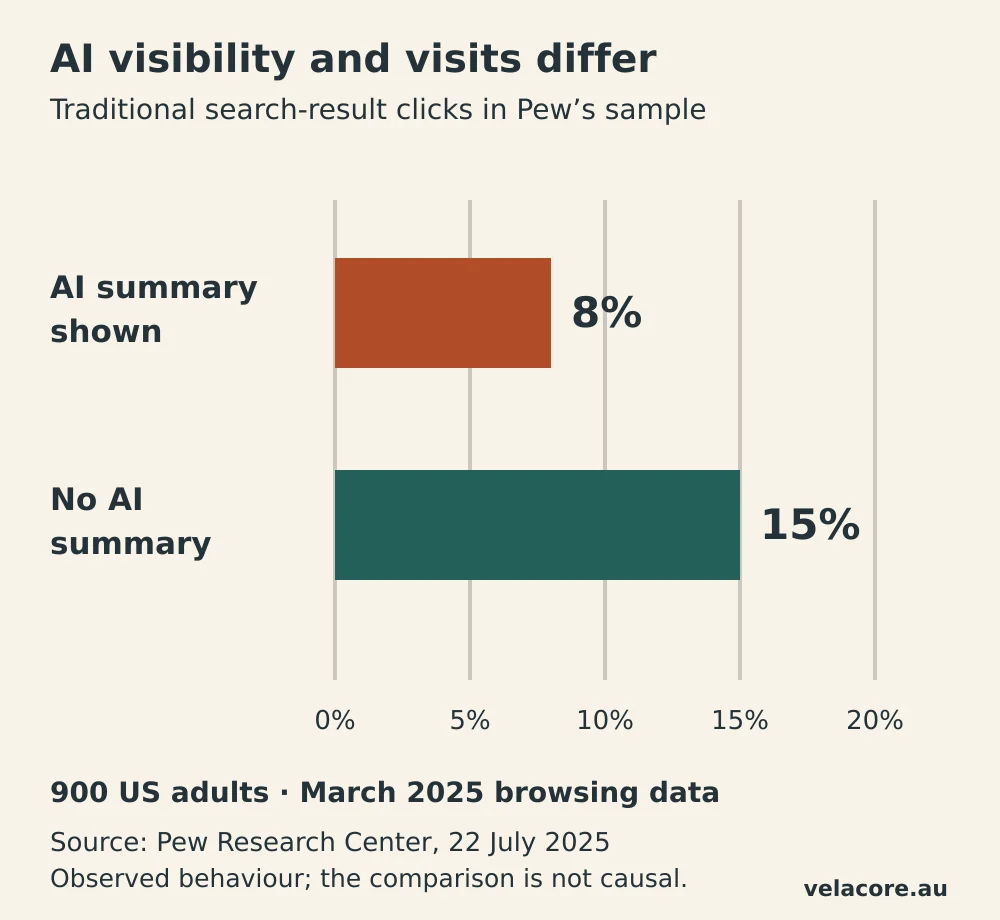
The distinction matters commercially. Pew’s analysis of 900 US adults’ March 2025 browsing found the 8% versus 15% traditional-result click difference, while links inside AI summaries were clicked on 1% of visits with a summary. It is an observational snapshot of Google behaviour, not a causal experiment or a forecast for every market.
For Google, use the Generative AI performance report in Search Console when available. It reports impressions from AI Overviews and AI Mode and supports dimensions such as pages, countries and devices. A missing report can mean insufficient impressions; it does not mean you have proved zero visibility.
Keep that evidence separate from identifiable AI referrals in GA4 and accepted enquiries or purchases in your business records. Explain unknowns instead of inventing attribution for traffic that has no identifiable referral. Our AI Overview visibility guide covers the ongoing interpretation in more depth.
If search impressions have continued while clicks fell, the AI Overview traffic-loss guide helps you investigate what changed before choosing the next edit.
8. Review the pilot by evidence and maintain the facts that change
Review the agreed questions and pages on a consistent schedule, then change the part the evidence identifies. A blocked source, a missing answer and an inaccurate citation require different repairs.
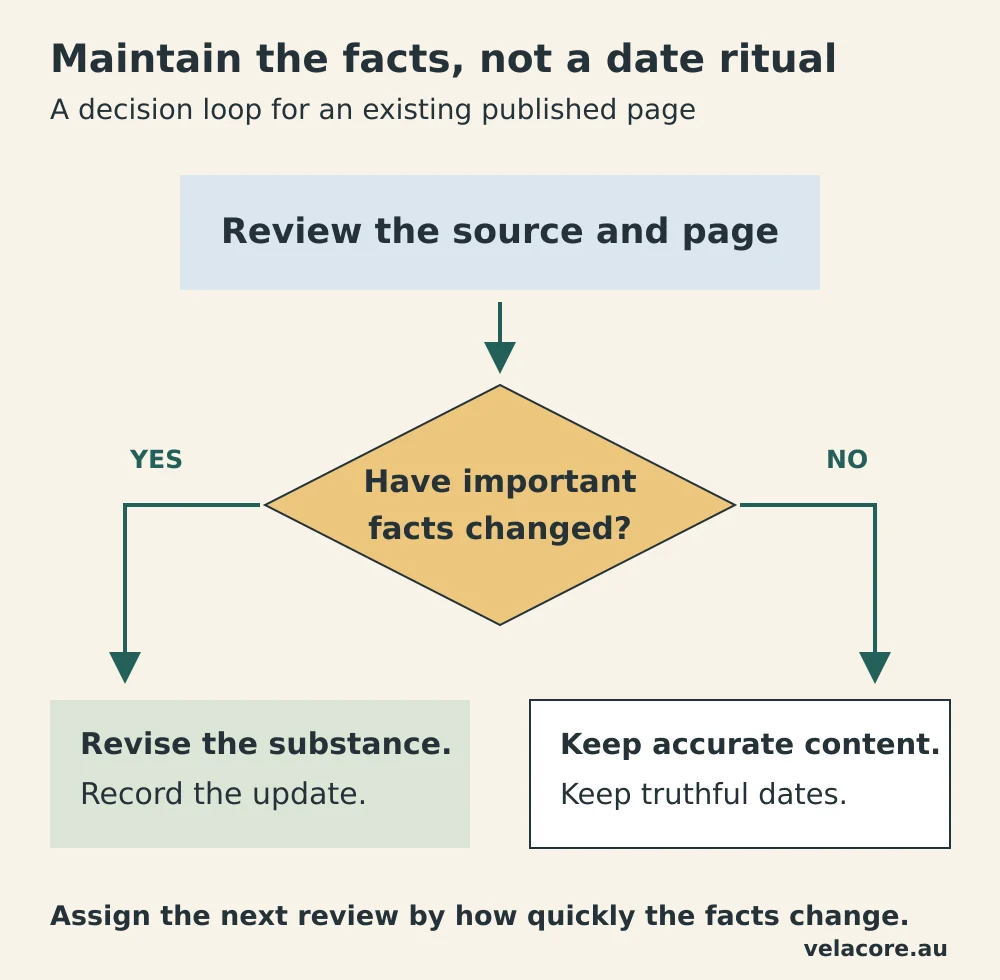
If the page cannot be fetched, investigate access. If the answer repeatedly uses other sources, compare their relevance and evidence before rewriting yours. If your page is cited inaccurately, examine whether its wording, scope or surrounding context invites that interpretation. If visibility improves but enquiries do not, inspect the buyer journey.
Assign factual review according to volatility. Pricing, product capabilities, access controls and rapidly changing research need attention when their sources change. Stable explanations do not become ineligible simply because two months have passed. Record a meaningful update when the content changes substantively, not as a recurring date-refresh exercise.
Watch for the expensive mistakes: publishing dozens of near-duplicate question pages, treating an invented fan-out list as telemetry, adding statistics the source does not support, counting mentions as citations and declaring a small fluctuation a proven result.
A useful pilot tells you what to change next. If the result is only a higher tool score, the measurement is not yet doing that job.
The release checklist is compact: a clear buyer decision, mapped URLs, approved facts, useful page structure, correct access decisions, verified publication, separate observations and an accountable next review. Complete those before extending the process across the whole site.
For teams applying the work across client accounts, the agency-focused AI search guide places those decisions in a wider delivery strategy.
Frequently asked questions about GEO implementation
What should I do first to optimise content for GEO?
Choose one commercially important topic and its existing pages, then record the current evidence. Identify the buyer questions, source gaps and technical blockers before editing. A small pilot with a named owner gives you a way to judge the work and learn what deserves a wider rollout.
Does every section need a 40-to-60-word answer?
No. Give a direct answer near the relevant heading, but use the space needed to explain it accurately. Google does not prescribe a chunk length for its AI search features. Readability and a complete answer matter more than meeting a fixed paragraph count.
Does blocking GPTBot prevent ChatGPT search citations?
OpenAI documents GPTBot and OAI-SearchBot as independent controls. GPTBot concerns training collection; OAI-SearchBot concerns ChatGPT search. User-requested visits are another purpose. Review the actual configuration and provider documentation rather than treating a training preference as a complete search-access policy.
Do I need special AI schema or llms.txt?
Google says neither special AI markup nor llms.txt is required for its Search AI features. Maintain accurate structured data as part of your existing SEO setup. A curated AI-readable export can serve other systems, but it is not a substitute for useful public pages, appropriate access or verified citations.
How quickly should a GEO pilot produce results?
Technical and publication checks can confirm a repair as soon as the changed page is served and tested. Search retrieval, indexing, answer selection and customer activity have different timelines. Set a review cadence, keep the baseline and report what has actually been observed instead of promising citations within a fixed number of days.
Should I rewrite every page to make it AI-friendly?
No. Prioritise pages where a meaningful buyer question, evidence gap or access problem has been identified. Preserve useful accurate material and established URLs. Expand the pilot when its findings show a repeatable improvement process, rather than using a generic checklist as a reason to rewrite the whole site.
Make the next GEO implementation decision concrete
To optimise content for GEO, build a useful source, verify how it is published and observe how it is used. Keep those checks connected without pretending they measure the same thing.
If your team needs help joining the content, technical and measurement work, explore Velacore’s SEO and AI search service or discuss a practical GEO implementation plan.