
Compare the work behind the quote, build a complete budget and protect what already works.
You ask three agencies to redesign the same website and receive three very different prices. One includes new copy, redirects and staff training. Another assumes you will provide every page and handle the migration. The third barely explains what happens after launch. Comparing the totals tells you surprisingly little.
Plan $4,500 to $6,500 AUD for a straightforward small-business website redesign with Velacore. That covers a new responsive design for up to five core pages using supplied content, a standard enquiry form, SEO migration checks and handover. A focused refresh needs less work; a larger rebuild or online store has a different scope.
The expensive mistake is buying a different project from the one you thought you approved.
- Choose the right level of work. Velacore’s redesign budget bands below connect the price to clear deliverables. Use our website cost calculator to explore wider page, content and functionality requirements.
- Budget for the existing site. Google’s migration guidance treats URL mapping, testing and monitoring as actual work.
- Define quality before launch. Google’s current Core Web Vitals cover loading, responsiveness and layout stability. A design approval is not a performance test.
1. Website redesign cost: Velacore’s budget guide
Choose the band that matches the work you need. A refresh improves a functioning site; a redesign replaces its presentation; a rebuild changes more of its structure and technical foundations.
| Redesign scope | Planning budget | Scope covered by the band |
|---|---|---|
| Focused website refresh | $2,500 to $3,500 | Visual and mobile layout improvements across up to 5 existing pages, retaining the current platform, navigation and supplied content. Includes checks of the affected pages and existing enquiry path. |
| Small business website redesign | $4,500 to $6,500 | Up to 5 core pages, a new responsive design, supplied content carried across, a standard enquiry form, on-page SEO setup, retained-URL checks and agreed redirects, testing and handover. |
| Business website rebuild | $7,500 to $10,000 | Up to 10 core pages, revised navigation and page templates, migration of supplied content, a standard enquiry form, SEO migration checks, testing and editor handover. |
| eCommerce redesign | $10,000 to $15,000 | An existing store with up to 50 products and supplied product data. Covers refreshed collection and product templates, cart and platform-supported checkout configuration, standard payment and shipping setup, URL review and purchase-path testing. |
A small-business redesign in this band assumes the content is ready and the site uses a standard enquiry form. Original copywriting, extra pages, catalogue cleanup, a platform change or custom integrations increase the work. Identify those requirements early so they can be priced in the proposal.
Custom platforms, complex store migrations and enterprise or government programmes are individually scoped around their workflows, data, accessibility, governance and integrations.
The Velacore calculator supports the broader scope discussion. Its build model adds page, content and functionality allowances; this redesign guide accounts for the existing content, platform and functions being retained. Use the guide to set a practical redesign budget, then use the calculator when exploring a wider build.
2. Decide whether to refresh, restructure or rebuild
A refresh improves a working system; a restructure changes how people find and understand information; a rebuild replaces substantial technical foundations. Choose the intervention that addresses the actual constraint.

If visitors understand the offer, forms reach the right team and editors can maintain pages, a stronger visual hierarchy or a few better templates may be enough. If customers cannot find the right service, the information architecture and copy need attention. If unsupported software or an unsuitable content model blocks essential work, a deeper rebuild may be justified.
Do not let an arbitrary birthday or a single Lighthouse score decide. A slow page might need smaller images or fewer third-party scripts. An HTTPS problem may need a configuration fix. Neither automatically means replacing the whole website.
Write down the three tasks the current site cannot support reliably. Ask the agency to show why each needs a rebuild rather than a targeted fix. If the explanation never moves beyond “it looks dated”, the scope is not ready.
That distinction also keeps the redesign separate from wider ambitions. A booking system, customer portal or AI assistant can be useful, but each needs a demonstrated purpose, an owner and a maintenance plan. Add the feature because it removes a real problem, not because the calendar has changed.
3. Count templates, content decisions and integrations
Redesign effort follows the number of different things the site must do and the quality of the material being moved. Ten similar service pages may reuse one template. A single pricing calculator can require its own logic, validation, integrations and testing.
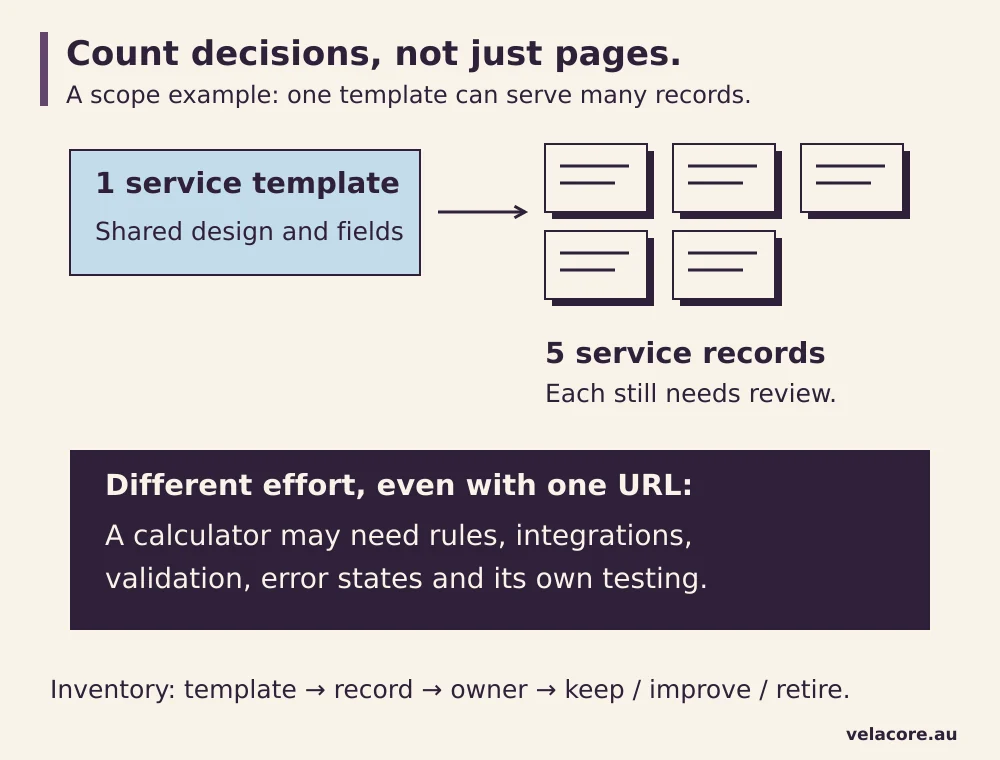
Ask for a content inventory before finalising the quote. Each existing page needs an owner and a decision: keep, improve, combine or retire. Include downloadable documents, images and important legacy URLs. Moving an old content problem into a new layout does not resolve it.
- Templates: list the distinct page types and responsive states, not just the number of URLs.
- Content: specify who writes, reviews, uploads and approves each section.
- Data: identify products, articles, locations or other records needing import and cleanup.
- Integrations: name the receiving system, required fields, failure handling and test owner.
- Access: confirm who controls the domain, hosting, analytics, code and accounts.
For a service business, follow an enquiry beyond the success message. Does it reach the CRM or inbox? Who receives a failure alert? What happens when someone submits twice? Those small operational details often separate a useful build from an attractive demonstration.
Velacore’s own website has separate marketing and WordPress publishing layers. Maintaining that arrangement involves shared navigation, article previews, image delivery and clear ownership of public URLs. That practical experience informs how we scope websites and platforms: the visible page is one part of the operating system around it.
4. Build the budget beyond the headline fee
A complete website redesign budget separates the project delivery from your team’s contribution and ongoing services. The example below allocates $6,000 to the delivery work, within Velacore’s small-business redesign band.
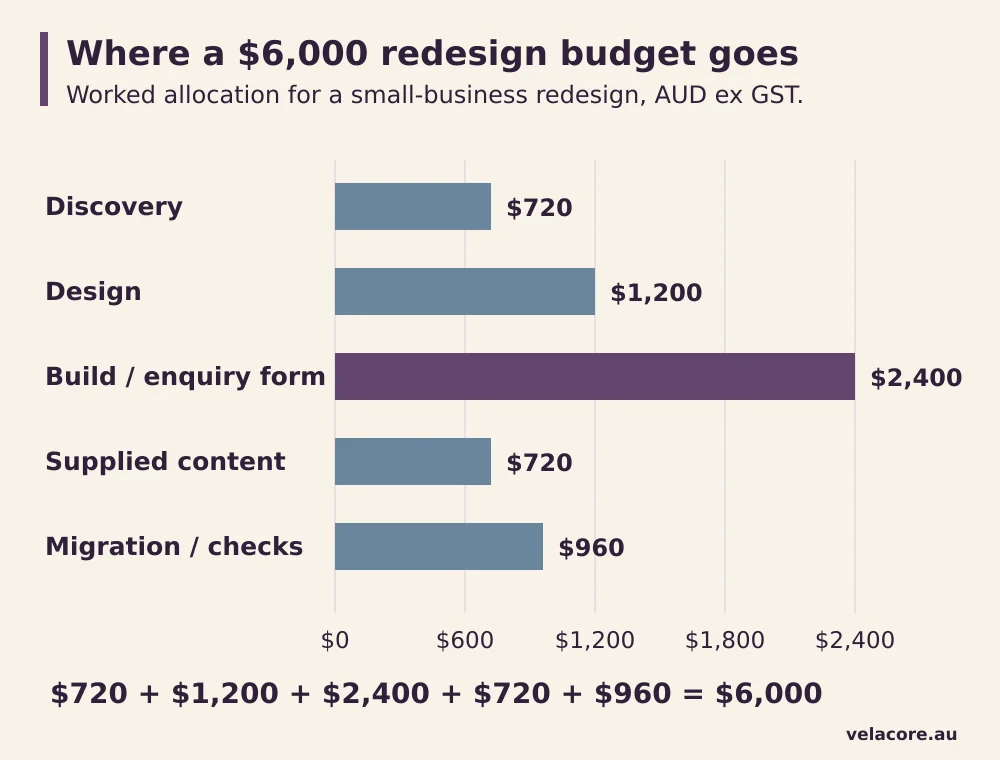
Here is a worked allocation for a small-business redesign using supplied content and a standard enquiry form. An illustrative 50 hours at AUD $120 per hour makes the arithmetic transparent. Your proposal prices the agreed project scope.
| Delivery work | Example allocation | Amount |
|---|---|---|
| Discovery and scope | 6 hours × $120 | $720 |
| Design and prototypes | 10 hours × $120 | $1,200 |
| Build and enquiry form | 20 hours × $120 | $2,400 |
| Supplied content preparation and entry | 6 hours × $120 | $720 |
| Migration and quality checks | 8 hours × $120 | $960 |
| Delivery total | 50 hours × $120 | $6,000 |
Look at the consequences of a vague exclusion. If “content supplied by client” becomes several weeks of interviews, writing and approvals, someone still has to do that work. If a CRM connection is priced as a simple form but needs routing, duplicate protection and recovery, the estimate must reflect the difference.
Recurring costs may include hosting, software licences, monitoring, maintenance and support. Ask who pays each supplier, what happens when a subscription ends and whether you can move the service. Keep future enhancements separate from the responsibility to fix defects in the agreed delivery.
A lower build price is not a lower total cost if the missing work comes back as variations.
5. Make SEO migration a deliverable, not a reassurance
SEO migration protects the useful relationships between your content, URLs, internal links and search signals during a redesign. The first question is whether the URLs need to change at all.
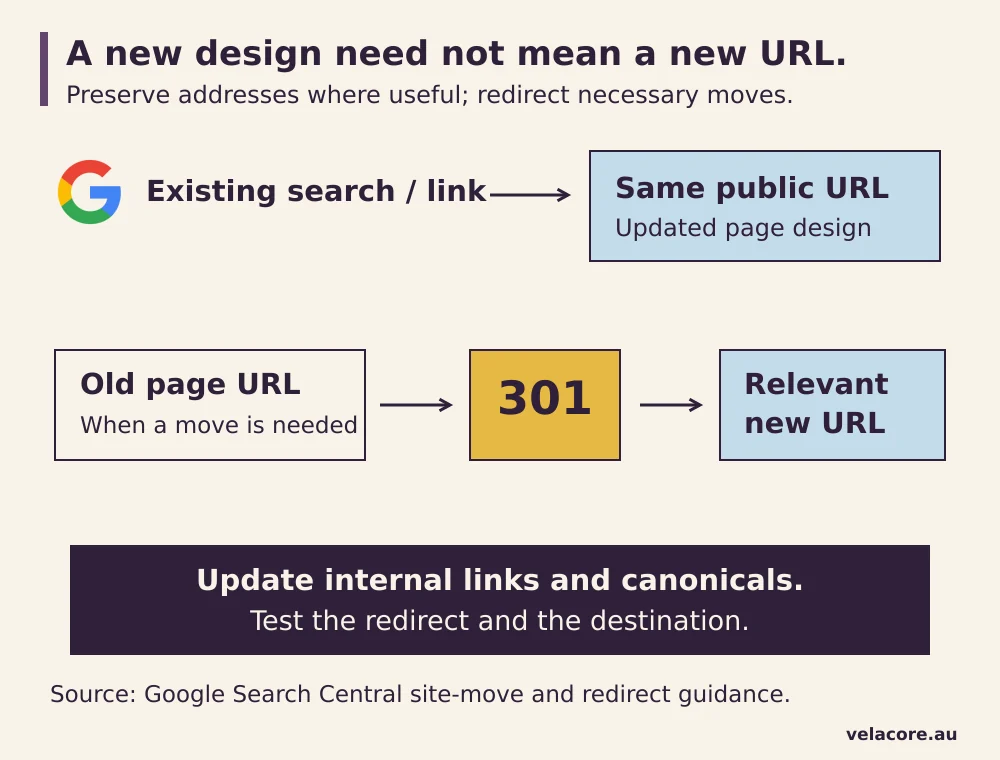
Keeping a URL avoids a move for that page. When a move is necessary, map the old address directly to its relevant replacement, update internal links and canonicals, and test the result. Google’s redirect guidance recommends permanent server-side redirects for permanent moves.
Do not redirect every retired page to the homepage or assume that a new platform requires new addresses. Identify what should be preserved, what is genuinely equivalent and what should return a proper removal response. Review images and downloads as well as HTML pages when their addresses change.
The migration scope should include:
- A baseline of important pages, search performance and meaningful conversion events.
- The URL inventory, destination decisions and redirect implementation.
- Titles, headings, canonicals, indexability, structured data and XML sitemaps.
- Tests for links, forms, images, documents and the live response codes.
- Named post-launch monitoring, escalation and recovery responsibilities.
Google’s site-move documentation also recommends changing major elements in stages where practical. A platform change, URL overhaul and complete content rewrite at once can make problems harder to diagnose. Rankings can fluctuate during a move; a checklist does not reserve a position in search. What you can demand is clear preparation, tested implementation and an owner for recovery.
6. Agree what good performance and accessibility mean
Quality becomes easier to price when it has observable acceptance criteria. Agree the pages, devices, user tasks and test evidence before the agency reaches the final invoice.
For performance, Google’s current good-experience thresholds are LCP at or below 2.5 seconds, INP at or below 200 milliseconds and CLS at or below 0.1, assessed at the 75th percentile of page loads across the relevant device group. Use them alongside lab testing and actual business tasks, not as a promise of rankings or sales.
For accessibility, include keyboard operation, visible focus, meaningful labels, useful error feedback, text resizing and a checkout or enquiry someone can complete. Use WCAG 2.2 to define the technical scope. Testing a polished homepage while ignoring forms and document journeys leaves important work unpriced.
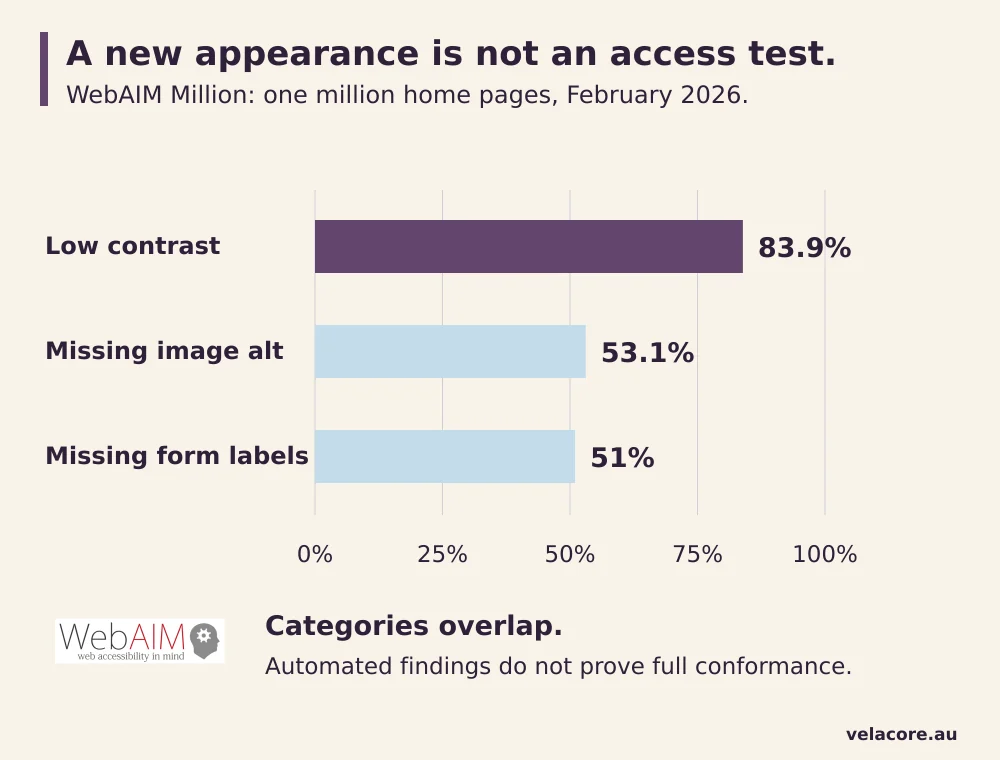
In its February 2026 automated sample of one million home pages, WebAIM detected WCAG failures on 95.9%. Low-contrast text appeared on 83.9%, missing image alternatives on 53.1% and missing form labels on 51%. These overlapping findings describe that sample, not your site or a complete manual accessibility assessment.
| Issue | Home pages affected |
|---|---|
| Low-contrast text | 83.9% |
| Missing image alternatives | 53.1% |
| Missing form labels | 51% |
Budget for fixing the tested journey, not merely installing an accessibility widget. The same discipline applies to privacy and security: define account access, data handling, update responsibilities and the recovery process rather than buying a vague “secure website” label.
7. Compare the quote, launch plan and handover together
A useful website redesign quote states what is included, who supplies the inputs, how work is accepted and what happens when something changes. Compare proposals against one shared checklist before comparing totals.
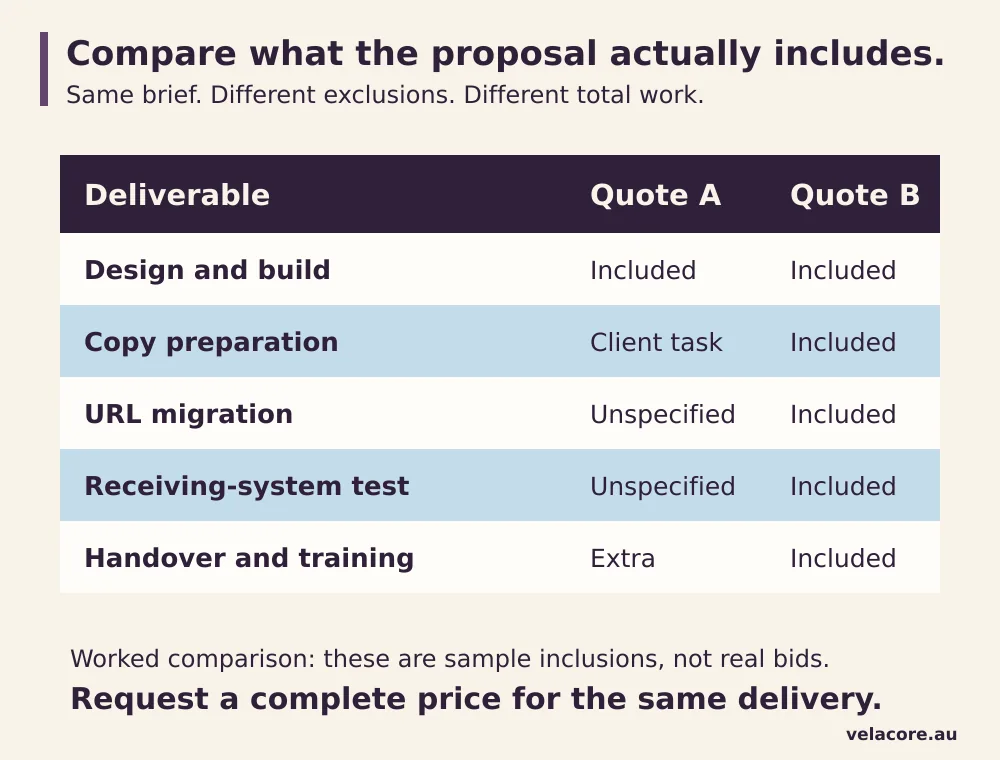
Ask each shortlisted supplier to identify the templates, content allowance, integrations, review rounds, migration work and testing. Clarify the difference between fixing an agreed defect and adding new scope. A variation needs a reason, an estimate and approval before work begins.
Build the schedule around dependencies. Content approval, access to an existing system, product data and a third-party integration can determine the launch date. A phased delivery works when each release has a useful outcome and a complete handoff; it works poorly when it creates two incompatible halves of the same journey.

Before signing off, have your own team edit a page, find an enquiry, locate account ownership and explain how to request help. Confirm who holds the domain and hosting accounts, what code or design deliverables you receive, and how a future supplier would take over.
Ask someone who did not build the site to publish a sample change and find a test enquiry using the supplied access and instructions. If they cannot finish, the project still has a handover task.
The best next step is a brief that names the current problems, the pages and systems worth preserving, the required outcomes and the available budget. Our web design agency selection guide helps you assess the team; this guide helps you assess the work.
A sensible website redesign cost buys a defined improvement and a system your team can operate. Get that scope clear, make the missing costs visible and decide what evidence will show the project is ready.
Frequently asked questions
How much should a small Australian business budget for a redesign?
Plan $4,500 to $6,500 AUD excluding GST for a small-business website redesign with Velacore. This covers up to five core pages using supplied content, responsive design, a standard enquiry form, SEO migration checks and handover. A focused refresh is $2,500 to $3,500; a larger business rebuild is $7,500 to $10,000. Ongoing services are separate.
Is a template redesign always the cheaper option?
A template can reduce design and build effort when it suits the content and required functions. It does not remove content preparation, migration, accessibility or testing. Compare the complete delivery rather than assuming a template is poor quality or custom design is automatically better.
Will a redesign damage my Google rankings?
A redesign can affect search performance when URLs, content, internal links, rendering or indexing change. Preserve useful addresses where practical, implement relevant permanent redirects for necessary moves and test before launch. Plan monitoring and recovery rather than accepting a guarantee that positions cannot change.
Can I keep my existing domain and URLs?
Usually, yes. A new design or platform does not inherently require a new domain or public URL pattern. Ask the implementation team to preserve useful addresses and document any change that is genuinely needed. Keep domain ownership and access under your business’s control.
Can we redesign in stages to spread the cost?
Yes, when each stage delivers a complete, usable outcome. Define the shared design and content foundations first, then sequence pages or functions around dependencies. A staged launch still needs tested forms, navigation, tracking and URL handling for the work being released.
How often does a website need a full redesign?
There is no universal replacement interval. Review whether the website supports customers and editors, uses maintainable technology and meets the required quality standards. Fix a bounded problem directly when that is sufficient. Choose a full redesign when the underlying constraints justify the work.
What should post-launch support include?
Agree the defect-reporting period, response expectations, maintenance responsibilities, account ownership and training. Separate ongoing hosting and software charges from new development. Specify how problems are reported, who handles them and what would require an additional quote.